What Is Agentic AI? A Plain-English Guide (and How It Differs from Generative AI)
Written by the Airtics Education academic team. Reviewed by an Airtics program advisor. Last updated 22 September 2026.
TL;DR: What is agentic AI? It is AI that does not just answer a question but works towards a goal: it plans steps, uses tools, checks its progress and adapts. It is built on the same generative AI models behind today’s chatbots, but it acts rather than only responds. Adoption is growing fast in business software, yet many projects stall, so understanding how agents work, and where they fail, is now a valuable skill.
Agentic AI in one sentence
Agentic AI is an AI system that can take a goal, decide how to achieve it, carry out the steps using software tools, and adjust when something does not go to plan, with a human setting the goal and approving important decisions.
Compare two requests. “Write an email apologising for a late delivery” is a generative AI task: you get a draft. “Handle this customer’s late delivery” is an agentic task: the system checks the order, finds the delay, offers the right compensation under your policy, sends the email and logs the case.
How an AI agent works
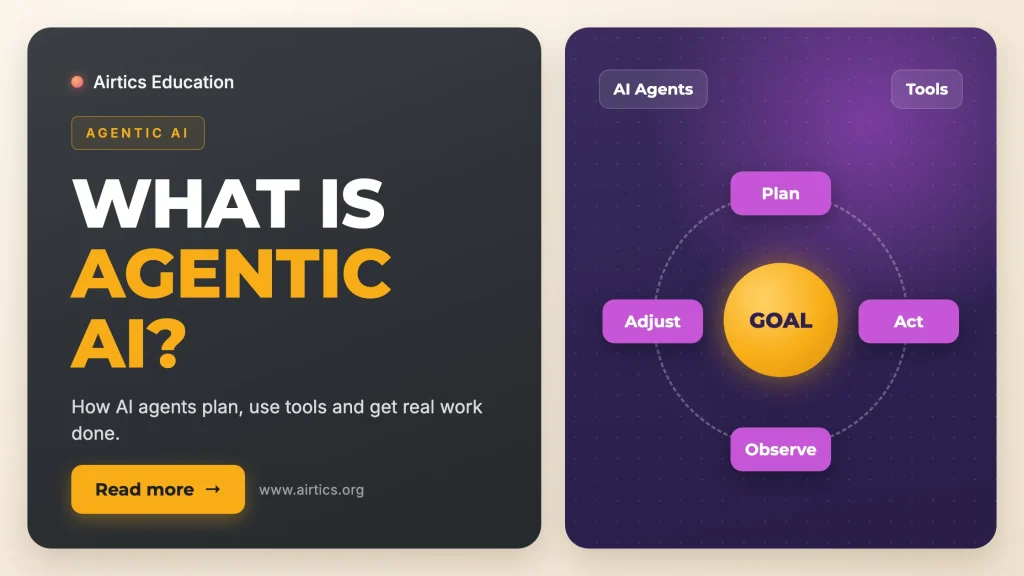
Most agents follow the same loop, repeated until the goal is met:
- Goal: a person or another system sets the objective.
- Plan: the model breaks the goal into steps.
- Act: it calls tools, such as a database query, a web search, a calendar or a company system.
- Observe: it reads the result of each action.
- Adjust: it revises the plan if a step fails or the result is unexpected.
Around this loop sit two essentials: memory, so the agent can keep track of what it has done, and guardrails, the rules and approval steps that stop it taking actions it should not.
Agentic AI vs generative AI
| Generative AI | Agentic AI | |
|---|---|---|
| What it does | Creates content in response to a prompt | Takes actions towards a goal |
| Steps | Usually one response | Many steps, planned and adjusted |
| Tools | Optional | Central: databases, apps, APIs, the web |
| Human role | Reviews the output | Sets goals, approves key actions, reviews outcomes |
| Typical example | Drafting a report | Researching, drafting and filing a report |
The two are not rivals. Agents use generative models as their “brain” for understanding and planning; agentic design adds the ability to act.
Agentic AI examples
- Customer service: resolving routine requests end to end, such as refunds, bookings and address changes.
- Finance operations: matching invoices to purchase orders and flagging exceptions for a person.
- IT support: diagnosing common problems, resetting access and escalating what it cannot fix.
- Research: gathering sources, comparing them and producing a summary with references.
- Software development: coding agents that write, test and fix code across a whole project.
Gartner predicts that 40% of enterprise applications will feature task-specific AI agents by the end of 2026, up from less than 5% in 2025, so many professionals will meet agents inside tools they already use.
The plumbing: how agents connect to tools
Agents are only as useful as the systems they can reach. The Model Context Protocol (MCP), created by Anthropic, has become a common standard for connecting AI models to tools and data. In December 2025 it was donated to the new Agentic AI Foundation under the Linux Foundation, alongside Block’s goose agent framework and OpenAI’s AGENTS.md, so that no single company controls these building blocks.
For organisations this matters because it makes agents easier to connect to existing systems, and easier to switch between AI providers.
Why many agentic AI projects stall
Agents are powerful, but they are not magic. Gartner predicts that more than 40% of agentic AI projects will be cancelled by the end of 2027 because of escalating costs, unclear business value or inadequate risk controls. Costs are a particular trap: every step an agent takes uses computing power, and Gartner also expects inference costs per agentic workflow to rise more than fivefold through 2028.
The projects that succeed tend to share three traits: a narrow, well-defined task; a clear measure of success, such as time saved or error rate; and human approval for anything with real consequences.
Agentic AI in the UAE
The UAE is an active early adopter. Abu Dhabi’s Government Digital Strategy 2025–2027 plans more than 200 AI solutions across government services as part of its goal to become an AI-native government by 2027, and businesses across the country are testing agents in customer service, finance and operations. Our overview of AI developments in the UAE in 2026 covers the wider picture.
Skills for working with AI agents
- Clear instructions: agents follow instructions literally, so structured prompting helps. See our Claude prompt hacks.
- Task design: breaking a process into steps and deciding where a person must approve.
- Evaluation: testing whether an agent actually completes the task correctly and safely.
- Data governance: knowing what data an agent may access. See why data governance matters for AI.
- Python and APIs: useful if you want to build or connect agents yourself.
You do not need a computer science background to start: many professionals move into AI from business roles. Read can you do a master’s in AI without coding? if that is you. For structured study, Airtics offers the Master’s in Generative AI and the Master’s in AI and Machine Learning, both delivered online and awarded by partner universities.
Frequently asked questions
What is agentic AI in simple terms?
Agentic AI is AI that can pursue a goal on its own: it plans the steps, uses tools such as search, email or business software, checks the results and keeps going until the task is done, usually with a person approving important actions.
What is the difference between agentic AI and generative AI?
Generative AI creates content, such as text, images or code, in response to a prompt. Agentic AI uses that ability to take actions towards a goal across several steps. Most AI agents are built on top of generative AI models.
What is the difference between AI agents and agentic AI?
An AI agent is a specific piece of software that carries out tasks. Agentic AI is the broader approach of designing AI systems that act with some autonomy. In everyday use the two terms are often used interchangeably.
Do I need to know how to code to work with AI agents?
Not to use them. Many agents are built into tools you already use. Coding, especially Python, helps if you want to build, connect or customise agents, and an understanding of how they work helps everyone use them safely.
Sources
- Gartner — 40% of enterprise apps will feature task-specific AI agents by 2026 (26 August 2025)
- Gartner — over 40% of agentic AI projects will be canceled by end of 2027 (25 June 2025)
- Gartner — AI inference costs per agentic workflow to rise more than fivefold through 2028 (17 August 2026)
- Linux Foundation — formation of the Agentic AI Foundation (December 2025)
- Department of Government Enablement, Abu Dhabi — Digital Strategy 2025–2027
Want guidance on your next step?
Thinking about building AI skills alongside your job? Tell us your goal and an Airtics advisor will point you to programmes that fit, with no obligation.