How AI Helped Engineer the Perfect Hinge for the iPhone Duo
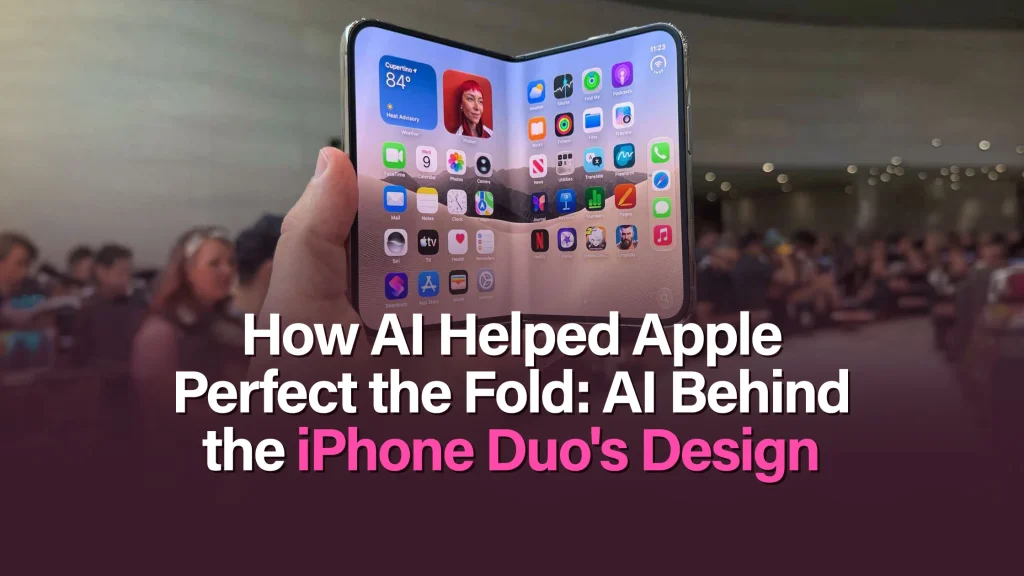
For years, foldable smartphones were bundled with a lot of mechanical compromise. While consumers appreciated expanding screens, they quietly endured wobbly hinges, unpredictable friction loss, and mechanisms that felt fragile over time. It took years for players like Samsung and Huawei to perfect their designs. Honestly speaking, the recent folds from these players are serious improvements. When Apple finally entered the foldable arena with the iPhone Duo, it didn’t just iterate on existing designs. They were learning from the R&D and failures of it’s competitors. And, when they finally launched their fold, Apple tried to bring out the best. AI helped them to engineer their ‘biggest hardware upgrade over 2 decades’. This blog is about that story.
At the heart of the iPhone Duo’s form factor is a masterclass in mechanical engineering: a custom-designed hinge system comprising over 100 microscopic components. Yet, the secret behind its butter-smooth motion and structural integrity isn’t just human ingenuity. It is the result of artificial intelligence and machine learning operating at a scale never before seen in consumer hardware manufacturing.
Story of how Apple used AI to engineer the ultimate foldable hinge.
The Challenges
To understand why AI was necessary, you have to look at the physics of a foldable hinge. A smartphone hinge must perform conflicting tasks simultaneously:
- It must allow effortless, fluid movement when opening and closing the device.
- It must maintain rigid stability when positioned at intermediate angles (such as a half-folded tabletop view).
- It must protect internal micro-cables from pinching while sealing out microscopic dust particles.
Historically, manufacturers relied heavily on trial-and-error prototyping. Engineers would build a physical hinge prototype, test it through thousands of mechanical cycles, observe where metal fatigue occurred, and tweak the CAD models. In the fast-paced world of consumer electronics, this iterative process is agonizingly slow and often leaves blind spots for edge-case wear patterns, such as how a device reacts when dropped at a specific angle after six months of repetitive twisting. Apple needed a faster, infinitely more precise approach.
Algorithmic Matching and Micron-Level Tolerances
To solve the variable wear problem, Apple’s engineering teams deployed specialized machine learning algorithms directly onto the production line.
- Component Pairing: A single iPhone Duo hinge integrates over 100 precision-machined alloy parts. Because microscopic manufacturing deviations are inevitable even with CNC milling, no two parts are identical down to the sub-micron level. Apple’s AI algorithms analyze the exact topological and dimensional profile of every manufactured part in real-time.
- Intelligent Sorting: Instead of random assembly, the AI matches complementary components; pairing a gear with a cam that possesses opposing microscopic variances. This ensures that friction coefficients across every single assembled hinge are virtually identical.
- Virtual Stress Testing: Before physical manufacturing even began, Apple ran millions of simulated folding cycles using generative AI models. These simulations mapped how thermal expansion, dropping shocks, and long-term tension would affect each component, allowing engineers to eliminate structural weak points before a single mold was cast.
Laser Scans and 3D-Printed Micro-Layers
Precision matching is only part of the equation; the outer shell and moving joints of the hinge must also remain sleek and debris-resistant. This is where AI met advanced additive manufacturing.
Once the core mechanical spine is assembled, confocal lasers scan the surface of each unit. The scan data is fed instantly into an AI spatial processor that maps out any microscopic surface irregularities. Based on this AI-generated map, automated systems apply up to 25 microscopic layers of a specially formulated photopolymer via high-precision 3D printing.
This hybrid manufacturing process – combining high-precision metal alloy stamping with AI-guided polymer micro-layers – creates a self-lubricating, frictionless surface. Dust cannot find a space in this tight engineering, and the physical parts glide past one another with a fluid grace that mimics high-end mechanical watchmaking rather than consumer electronics.
Perfecting the User Experience: The “Car Door” Sna
All of this backend algorithmic optimization translates directly into tangible user experience improvements that set the iPhone Duo apart.
The Haptic Snap: The satisfying, weighted snap you feel when closing the iPhone Duo is precisely calibrated by AI to mimic the solid closure of a luxury car door. We have to give up to Apple for using AI and other resources to this extent to improve the customer experience.
Free-Stop Stability: When you half-fold the device for FaceTime or media viewing, the hinge holds its position effortlessly without drooping or sagging over time. The free-stop stability is still a hard nut to crack for many manufacturers. This feature got some serious real-world utility than a marketing gimmick.
The bottomline – AI in manufacturing can do wonders
The iPhone Duo’s hinge is a proof of how artificial intelligence is transforming physical product design. By turning to machine learning for component pairing, stress simulation, and automated micro-layering, Apple bypassed the traditional limitations that held back early foldables and accelerated the R&D turn around time.
The result is truly impressive. The author is sure that many competitors will look into how it is made and bring some similar engineering in their upcoming models. Apple was able to come up with a hinge that feels less like a moving part and more like a natural extension of the device itself. For the foldable market, the quality bar just got another step, thanks to brilliant minds at Apple and AI!