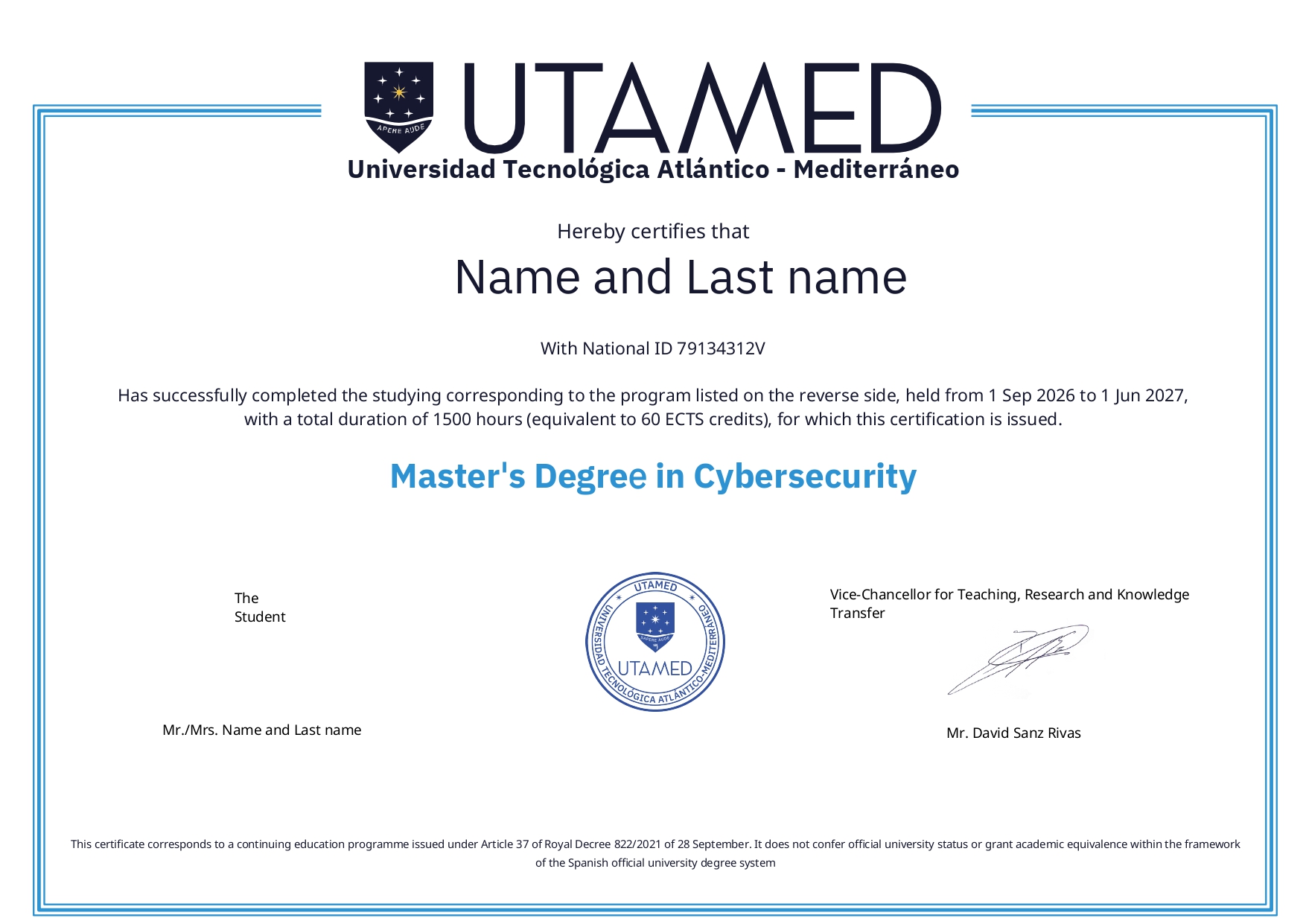
The Master’s in Cybersecurity is a one-year postgraduate programme focused on advanced, practice-oriented learning in securing digital systems. It covers network security, cryptography, risk management, digital forensics, and emerging threats. The programme combines technical expertise with governance and research skills, preparing graduates for cybersecurity roles and applied research pathways.
Work hands-on with the tools and methods used to protect modern organisations. The Master’s in Cybersecurity covers network and infrastructure security, cryptography and secure systems, cyber risk management and digital forensics, and ends with a research methods module and a capstone project.
Work hands-on with the tools and methods used to protect modern organisations. The Master’s in Cybersecurity covers network and infrastructure security, cryptography and secure systems, cyber risk management and digital forensics, and ends with a research methods module and a capstone project.
Universidad Tecnológica Atlántico Mediterráneo (UTAMED), Spain, is a forward-thinking university based in Málaga, a growing European hub for technology and innovation. Known for its strong emphasis on applied learning, UTAMED integrates academic excellence with industry relevance, focusing on skills-based education, research-driven practice, and real-world impact. The university is committed to bridging the gap between academia and industry while preparing graduates who are highly employable and globally aware.
The Master’s in Cybersecurity is a one-year postgraduate programme designed to develop advanced expertise in protecting digital systems, networks, and data. It covers key areas such as network security, cryptography, cyber risk management, digital forensics, and emerging technologies like AI and IoT security. The programme combines technical depth with governance, ethics, and compliance, supported by applied learning and a research-based dissertation. Graduates are prepared for roles in cybersecurity engineering, risk management, forensics, and strategic cyber defence, contributing to resilient digital ecosystems.
Eligibility
Students seeking admission to this programme should hold a Bachelor’s degree from a recognised institution. The programme is designed for graduates from diverse academic backgrounds, though a foundation in computing, information technology, engineering, or related disciplines is considered advantageous. Applicants should demonstrate the ability to engage with technical, analytical, and research-oriented postgraduate study in cybersecurity.
Prerequisites
While prior experience in cybersecurity is not mandatory, a basic understanding of computing concepts and digital systems will enhance the learning experience. Familiarity with fundamental networking principles, logical reasoning, and data handling will be beneficial. Basic computer literacy and the ability to work with digital tools and platforms are essential for effectively engaging with the coursework and applied components of the programme.
This module introduces students to the principles, concepts, and frameworks underpinning modern cybersecurity practice in modern organizations. It provides a comprehensive foundation for understanding cyber threats, vulnerabilities, and attack vectors, alongside the core defensive strategies used to protect information systems and digital assets. Students will examine cybersecurity architectures, security controls, and foundational risk management principles within diverse organisational and technological contexts. The module also introduces ethical, legal, and professional considerations relevant to cybersecurity practice across international jurisdictions, forming a strong conceptual and technical base for advanced postgraduate study in cybersecurity.
Learning Outcomes
By completing this module, you will:
LO1: Critically analyse the fundamental concepts, principles, and terminology of cybersecurity within modern digital systems.
LO2: Critically evaluate common cyber threats, vulnerabilities, and attack methodologies affecting organisations and individuals.
LO3: Apply basic cybersecurity controls and defensive mechanisms to protect information systems.
LO4: Interpret cybersecurity risks within technical, organisational, and regulatory contexts
Network and Infrastructure Security
This module develops advanced knowledge and applied skills in securing contemporary networked, cloud-based, and hybrid infrastructures. It explores network architectures, communication protocols, vulnerabilities, and defensive mechanisms essential for protecting enterprise and critical information infrastructures. Emphasis is placed on secure network design, monitoring, intrusion detection and prevention, and resilience against sophisticated cyberattacks. Students will critically evaluate network security risks across on-premise, cloud, and hybrid environments, preparing them to design, assess, and manage secure network infrastructures in complex organisational settings.
Learning Outcomes
Module Duration: 4–6 weeks
By completing this module, you will:
LO1: Critically analyse network architectures and communication protocols to identify security weaknesses.
LO2: Design and evaluate secure network infrastructures using advanced security controls and best practices.
LO3: Apply intrusion detection, prevention, and monitoring mechanisms in enterprise environments.
LO4: Critically assess network security risks in on-premise, cloud, and hybrid infrastructures.
Cryptography and Secure Systems
This module provides a rigorous and systematic understanding of cryptographic principles and their application in the design and operation of secure information systems. Students will explore symmetric and asymmetric cryptography, cryptographic protocols, authentication mechanisms, and key management infrastructures that underpin secure communication and data protection. The module emphasises both theoretical foundations and practical implementation considerations, including common cryptographic vulnerabilities and failures. Students will develop the ability to evaluate, apply, and integrate cryptographic solutions within secure systems across distributed, cloud, and emerging computing environments.
Learning Outcomes
By completing this module, you will:
LO1: Critically evaluate cryptographic algorithms and protocols for secure information exchange.
LO2: Apply cryptographic techniques to ensure confidentiality, integrity, authentication, and non-repudiation.
LO3: Design secure systems incorporating encryption and key management mechanisms.
LO4: Critically analyse vulnerabilities arising from improper cryptographic implementations.
Cyber Risk Management, Governance and Compliance
This module examines cybersecurity from a strategic, organisational, and governance perspective, focusing on managing cyber risk in alignment with business and regulatory requirements. Students will develop competencies in cyber risk assessment, security governance structures, organisational policies, and compliance with international legal and regulatory frameworks. The module emphasises the integration of cybersecurity strategy with organisational objectives, ethical responsibility, and accountability. Students will be equipped to design and evaluate risk-based cybersecurity strategies that support organisational resilience and regulatory compliance in complex digital environments.
Learning Outcomes
By completing this module, you will:
LO1: Critically assess cyber risks using qualitative and quantitative risk management frameworks.
LO2: Critically evaluate cybersecurity governance models and organisational security policies.
LO3: Interpret and apply international cybersecurity laws, regulations, and standards.
LO4: Develop risk-based cybersecurity strategies aligned with business objectives.
Digital Forensics and Incident Response
This module equips students with advanced knowledge and practical skills in detecting, analysing, and responding to cybersecurity incidents. It covers digital forensic principles, incident response planning, evidence acquisition, and post-incident analysis to support legal, regulatory, and organisational requirements. Students will engage with forensic tools, methodologies, and incident response frameworks used in enterprise and critical environments. The module also addresses business continuity, disaster recovery, and legal considerations, enabling students to manage cyber incidents effectively while preserving evidential integrity and organisational resilience.
Learning Outcomes
By completing this module, you will:
LO1: Critically analyse cybersecurity incidents using systematic forensic methodologies.
LO2: Apply incident response frameworks to contain, eradicate, and recover from cyber incidents
LO3: Critically evaluate digital evidence while maintaining legal and procedural integrity.
LO4: Design incident response and business continuity plans.
Cybersecurity Applications
This module explores advanced and emerging domains in cybersecurity, preparing students to anticipate and respond to evolving and future cyber threats. It examines sophisticated attack techniques, including AI-driven threats, as well as advanced defensive strategies applied in high-risk, large-scale, and critical environments. Students will evaluate the security implications of emerging technologies such as artificial intelligence, IoT, blockchain, and automated DevOps pipelines. The module emphasises interdisciplinary thinking, strategic foresight, and applied problem-solving, enabling students to design innovative and resilient cybersecurity solutions for complex and rapidly changing threat landscapes.
Learning Outcomes
By completing this module, you will:
LO1: Critically analyse emerging cybersecurity threats and attack techniques.
LO2: Critically evaluate the security implications of emerging technologies.
LO3: Design advanced defensive strategies for complex cyber environments.
LO4: Synthesize interdisciplinary knowledge to address novel cybersecurity challenges.
Quantitative & Qualitative Study Designs
Explore major research approaches including quantitative, qualitative, and mixed methods. Understand how to design and implement various study types, from experimental designs to ethnographic studies, with specific applications in AI and technology contexts.
Learning Outcomes
By completing this module, you will:
LO1: Conduct independent research addressing a cybersecurity problem.
LO2: Apply appropriate methodologies and analytical techniques.
LO3: Critically analyse and synthesise research findings.
LO4: Communicate research outcomes clearly in written and oral form.
Your Success Story Starts Here
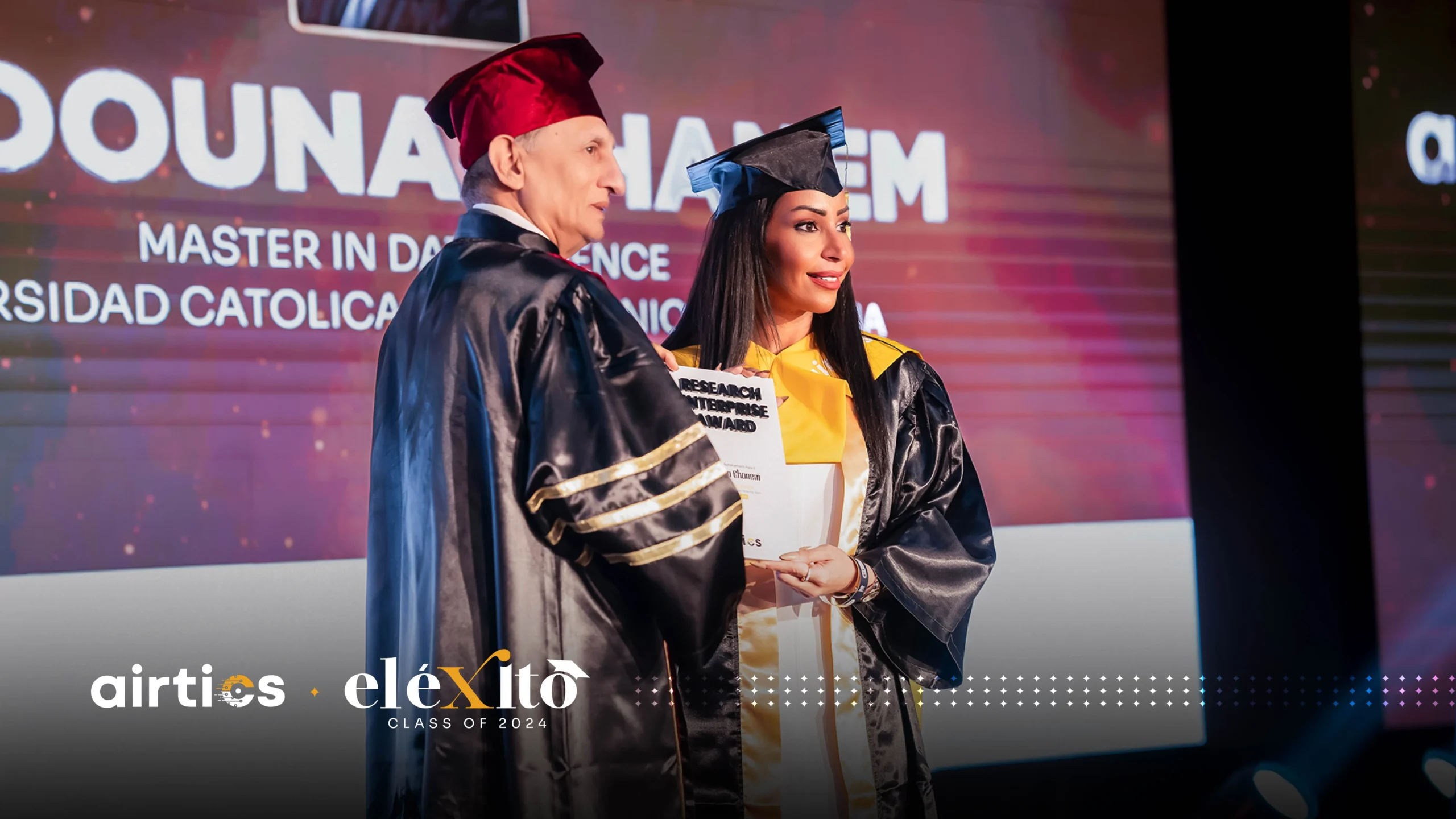
Every image here tells a story of transformation, dedication, and success. Be the next to wear the cap and gown. Enroll today, and let your journey begin.
Every student has a story—of ambition, of challenge, of growth. In their own words, they share how Airtics became a turning point in their learning journey and helped them move closer to their goals.
Pemsith Ravi
Thanks to the support of this prestigious institution – airtics. I was able to earn a master’s degree in data science. I had a fantastic educational experience there, and they possess a highly competent and knowledgeable lecturing panel. Anyone looking to make it major in the data science field should enrol in their course.
Verified Review
Zeeshan Ali
Airtics offers a truly transformative learning experience. The course content is up-to-date, the mentors are incredibly supportive, and the flexibility of the online platform made it easy to balance with my work. Highly recommended for anyone looking to upskill!
Verified Review
Aalaa Shbair
The experience at Airtics College has been tremendous for me. It has illuminated my path and opened the way for me to become a developer of solutions in my workplace. I cherish every moment of this online learning experience and the supportive community of instructors and peers.
Verified Review
Muhammad Fatouh
Airtics offered a great platform that allowed me to take a meaningful step forward in data science while balancing my demanding job as a telecom engineer. If you have a busy schedule and struggle with work-life balance, I encourage you to find a flexible platform like Airtics to pursue your goals.
Verified Review
Al Tayyab Bakhsh
Coming from a non-technical background in marketing, switching to data science was challenging. The faculty at Airtics was incredibly helpful, especially my mentor Miss Piyali, who guided me with patience every step of the way. Their mentorship gave me the confidence to succeed.
Verified Review
Dilnawaz Qureshi
Airtics provides an impressive curriculum for Python Full Stack development that is both well-structured and up-to-date. This comprehensive approach ensures we acquire a thorough understanding of the field and are well-prepared for real-world challenges.
Verified Review
Charuhaas Shenoy
Airtics offers a truly transformative learning experience. The course content is up-to-date, the mentors are incredibly supportive, and the flexibility of the online platform made it easy to balance with my work. Highly recommended for anyone looking to upskill!
Verified Review
Madonna Ghanem
The resources provided by Airtics for AI and ML students are top-notch. The institute has a well-equipped virtual lab with the latest software, allowing us to experiment with complex algorithms. The online library offers a wide range of reference materials and research papers.
Verified Review
Dhruv Narse
Airtics provides a conducive learning environment for data analytics students. They have experienced faculty, and provide access to the latest software and tools used in the industry. This ensures that we are well-prepared for our future careers in the field.
Verified Review
What Our Students Say
Every student has a story—of ambition, of challenge, of growth. In their own words, they share how Airtics became a turning point in their learning journey and helped them move closer to their goals.
Pemsith Ravi
Thanks to the support of this prestigious institution – airtics. I was able to earn a master’s degree in data science. I had a fantastic educational experience there, and they possess a highly competent and knowledgeable lecturing panel. Anyone looking to make it major in the data science field should enrol in their course.
Verified Review
Zeeshan Ali
Airtics offers a truly transformative learning experience. The course content is up-to-date, the mentors are incredibly supportive, and the flexibility of the online platform made it easy to balance with my work. Highly recommended for anyone looking to upskill!
Verified Review
Aalaa Shbair
The experience at Airtics College has been tremendous for me. It has illuminated my path and opened the way for me to become a developer of solutions in my workplace. I cherish every moment of this online learning experience and the supportive community of instructors and peers.
Verified Review
Muhammad Fatouh
Airtics offered a great platform that allowed me to take a meaningful step forward in data science while balancing my demanding job as a telecom engineer. If you have a busy schedule and struggle with work-life balance, I encourage you to find a flexible platform like Airtics to pursue your goals.
Verified Review
Al Tayyab Bakhsh
Coming from a non-technical background in marketing, switching to data science was challenging. The faculty at Airtics was incredibly helpful, especially my mentor Miss Piyali, who guided me with patience every step of the way. Their mentorship gave me the confidence to succeed.
Verified Review
Dilnawaz Qureshi
Airtics provides an impressive curriculum for Python Full Stack development that is both well-structured and up-to-date. This comprehensive approach ensures we acquire a thorough understanding of the field and are well-prepared for real-world challenges.
Verified Review
Charuhaas Shenoy
Airtics offers a truly transformative learning experience. The course content is up-to-date, the mentors are incredibly supportive, and the flexibility of the online platform made it easy to balance with my work. Highly recommended for anyone looking to upskill!
Verified Review
Madonna Ghanem
The resources provided by Airtics for AI and ML students are top-notch. The institute has a well-equipped virtual lab with the latest software, allowing us to experiment with complex algorithms. The online library offers a wide range of reference materials and research papers.
Verified Review
Dhruv Narse
Airtics provides a conducive learning environment for data analytics students. They have experienced faculty, and provide access to the latest software and tools used in the industry. This ensures that we are well-prepared for our future careers in the field.
Verified Review
Learn from Industry Leaders & Experts
Learn from the best in the field. Our faculty combines academic brilliance with industry expertise, featuring PhD holders, senior data scientists, and AI researchers from top organizations.
Ms. Piyali Mondal
Head of Department
Ms. Priti Mondal
Associate Faculty
Dr. Abdullah El-Nokiti
Professor
Dr. Mohd Merajuddin Inamdar
Professor
Dr. Madhavi Vaidya
Professor
Dr. Poonam Chaudhari
Professor
Dr. Anup Kumar Maurya
Professor
Dr. Milan Amrutkumar Joshi
Industry Expert
Dr. Mohamed Elhaw
Industry Expert
Dr. Pradeep Tiwari
Industry Expert
Global Student Community
Students from 60+ Countries Worldwide
Frequently Asked Questions
Find answers to common questions about our Master of Artificial Intelligence in Business program. Learn about program details, requirements, and what to expect from this 12-month UCAM-certified degree program.
Why should I join the AI in Business program?
AI is transforming every industry from healthcare to finance, retail to manufacturing. This program equips you with the strategic knowledge to lead AI implementation in business contexts. You’ll gain practical skills in data analytics, machine learning, and business intelligence while earning a respected European university degree.
What if I fail to attend the classes?
All live sessions are recorded and available through our Learning Management System (LMS). You can access missed classes anytime and review course materials at your convenience. Our flexible learning format accommodates working professionals with busy schedules, ensuring you never fall behind.
How does AI in Business differ from traditional MBA programs?
This program specifically focuses on artificial intelligence applications in business strategy, operations, and decision-making. Unlike traditional MBAs, you’ll learn hands-on AI tools like Python, machine learning algorithms, and data visualization platforms while developing strategic business acumen for the AI-driven economy.
What can I expect from the AI in Business program?
You’ll complete 7 comprehensive modules covering data science, machine learning, operations management with AI, and international HR management with AI. The program includes 200 hours of live training, 6 assignments, 3 industry-based projects, and a capstone project with real business applications.
Who can join the program?
This program is designed for business professionals, managers, consultants, and anyone seeking to advance their career in AI-driven business environments. You need a bachelor’s degree and English proficiency. The course accommodates beginners, providing foundational knowledge before advancing to complex topics.
Do I need prior experience in AI or coding to learn the program?
No prior AI or coding experience is required. The program starts with Python fundamentals and gradually builds your technical skills. We provide comprehensive foundational training in mathematics, programming, and AI concepts before advancing to business applications and strategic implementations.
What are the current capabilities of Artificial Intelligence in business?
AI currently powers predictive analytics, customer lifetime value modeling, supply chain optimization, automated decision-making, personalized marketing, fraud detection, and operational efficiency improvements. The program covers real-world applications across healthcare, finance, retail, and manufacturing industries.
What career opportunities are available after completion?
Graduates pursue roles as AI Business Analysts, Data Science Managers, AI Strategy Consultants, Business Intelligence Directors, Digital Transformation Leaders, and AI Project Managers. Our 94% placement success rate demonstrates strong industry demand for AI-skilled business professionals.
Is the degree internationally recognized?
Yes, the Master’s degree is awarded by Universidad Católica de Murcia (UCAM), a fully-accredited European university. UCAM is accredited by ANECA (National Agency for Quality Assessment and Accreditation of Spain) and recognized by the Ministry of Education, ensuring global recognition.
What support is provided during the program?
You’ll receive 24/7 LMS access, dedicated student mentors, live instructor support, and guidance from industry professionals. Our faculty includes experienced academics and practitioners who provide personalized feedback on assignments and projects throughout your learning journey.
Can I complete this program while working full-time?
Absolutely. The program is designed for working professionals with flexible scheduling, recorded sessions, and online learning format. You can access materials anytime, participate in live sessions according to your schedule, and complete assignments at your own pace while maintaining work commitments.
What is the difference between the capstone project and assignments?
Assignments are module-specific exercises that reinforce learning concepts. The capstone project is a comprehensive, industry-based challenge where you collaborate with business mentors to solve real-world problems, applying all program knowledge to create a portfolio-worthy solution that demonstrates your expertise to employers.
Still have questions?
If you have any other questions or need further information about our Master of Artificial Intelligence in Business program, don’t hesitate to contact us. Our admissions team is here to help you take the next step in your AI career journey.
Laya and Jev are a new kind of AI: they pick answers instead of writing text. How they work in plain words, how to try Laya free and where they fit at…