Going Small in the AI Race: Shopify’s Unusual Strategy for Building Better AI
The AI race has become a competition of bigger and bigger numbers. More parameters. More computing power. More data. More expensive training runs.
Companies such as OpenAI, Google and Anthropic are spending billions to build increasingly powerful frontier models. The assumption is simple: if you want better AI, build a bigger model.
Shopify CEO Tobi Lütke thinks there may be another way. Instead of trying to compete directly with the companies building the largest general-purpose AI models, Shopify is exploring something much more focused: small AI models trained to become exceptionally good at specific tasks. It sounds less ambitious. In practice, it could be a very clever strategy. Through this blog, let’s see how this strategy will be used in a lot of real-world e-commerce and business scenarios.
Bigger Isn’t Always Better
Large language models are incredibly capable because they are trained to handle a huge range of tasks. They can write, code, analyse information, and whatnot! But that flexibility comes at a cost.
A large model may be far more powerful than necessary for a simple, specialised job. If an AI system only needs to classify customer requests, generate a particular type of product description or perform a specific operation inside Shopify, using a massive general-purpose model for every request can be inefficient.
This is where smaller models become practical. A smaller model can be trained specifically for one task. Instead of knowing a little about everything, it can become extremely good at one thing that actually matters to the business.
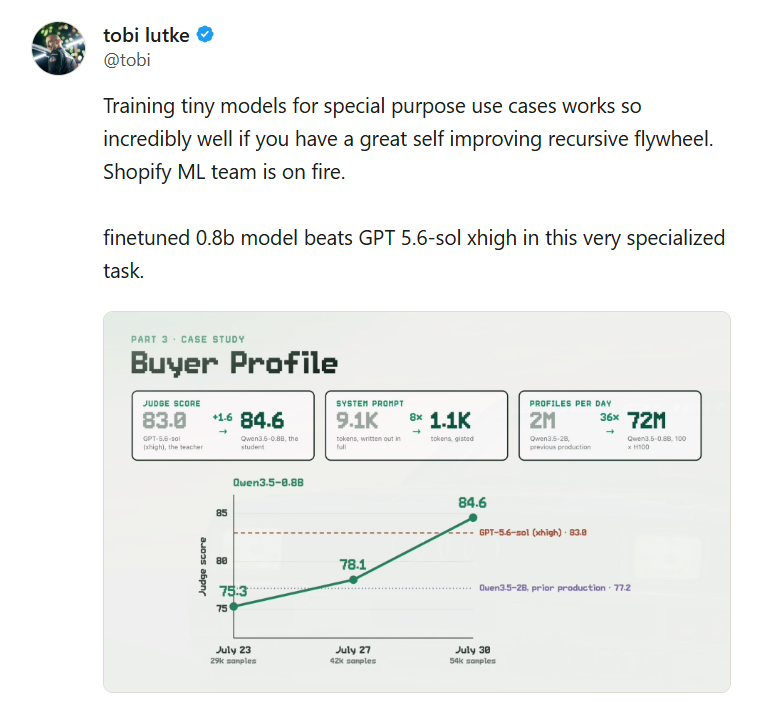
Shopify’s Self-Improving AI Flywheel
The interesting part of Shopify’s approach isn’t simply that the company wants to build smaller models. It is how those models are supposed to improve over time.
The basic idea is a self-improving flywheel. Shopify can take a specific task, train a relatively small model to perform it, evaluate how well it works, identify where it fails and use those results to create better training data. The improved data can then be used to train a better version of the model.
This is a cycle, with better models comes better results. They serve as fuel for further growth, because better results are give more useful data for better training and the cycle continues.
Instead of relying entirely on the enormous scale of frontier-model companies, Shopify can use its own products, workflows and real-world business problems as an advantage.
That is an important distinction. Shopify isn’t trying to build an AI that knows everything. It is trying to build AI that knows what Shopify needs it to know.
The Platform Behind the Idea
Lütke has also shared the internal platform Shopify built to support this approach. You can access it at: https://tangleml.com/
The platform is designed around developing, testing and improving specialised models rather than treating AI as a single giant system. That matters because building AI is increasingly becoming less about simply having access to a powerful model and more about creating the infrastructure around it.
Companies need to know which model should handle which task, how to evaluate its performance, how to collect useful feedback and how to continuously improve it.
Shopify’s approach essentially turns this into an engineering system. Think of it like a team of specialists rather than one employee who is expected to do everything.
One model might be extremely good at one type of coding task. Another could handle a particular customer-support workflow. Another might specialise in understanding information from Shopify’s own systems.
The individual models don’t have to be the most powerful AI models in the world. They just need to be really good at the jobs they were built for. Why This Could Be a Smart Business Strategy. There is also a financial argument behind this.
Running large AI models can be expensive, particularly when millions of users are making requests. If a smaller model can deliver an equally useful result for a particular task, the economics can look very different.
This could mean lower computing costs, faster responses and greater control over the AI systems being used. It could also reduce Shopify’s dependence on external AI providers.
That’s becoming increasingly important as AI becomes a core part of software products.
If a company builds its entire AI strategy around someone else’s model, it may eventually find itself dependent on that provider’s pricing, availability, capabilities and product roadmap.
Developing specialised models internally gives Shopify another layer of control.
Unique Advantage Shopify Got
Perhaps the biggest advantage Shopify has is not its access to computing power. It is its domain knowledge.
Shopify has spent years building software for merchants, businesses and online retailers. It understands the problems those businesses face and has access to a huge ecosystem of workflows where AI can potentially be applied.
That creates an interesting opportunity. A general-purpose AI company has to build models that work for almost everyone. Shopify can focus on making AI work exceptionally well for commerce. That difference could become increasingly valuable.
Imagine an AI system that isn’t merely capable of writing text, but understands why a particular product description might help a merchant sell more. Or an AI system that understands the specific steps involved in managing an online store and can automate them efficiently.
A Different Way to Think About the AI Race
Shopify’s strategy also raises a bigger question about where the AI industry is heading.
For the past few years, the conversation has largely centred around frontier models. Every new generation is compared by benchmarks, parameter counts, and n number of other metrics. But businesses don’t necessarily need the world’s smartest AI. They need AI that can solve their problems reliably and affordably.
This is where Shopify’s strategy makes sense. Shopify’s strategy isn’t really about going small. It is about going focused. And that may prove to be one of the most interesting directions in the AI race. Because as AI models become more powerful, the next challenge may not be making them bigger. It may be figuring out how to make them better at exactly what we need them to do.