How AI Is Reshaping Elderly Care A Case Study of Ato
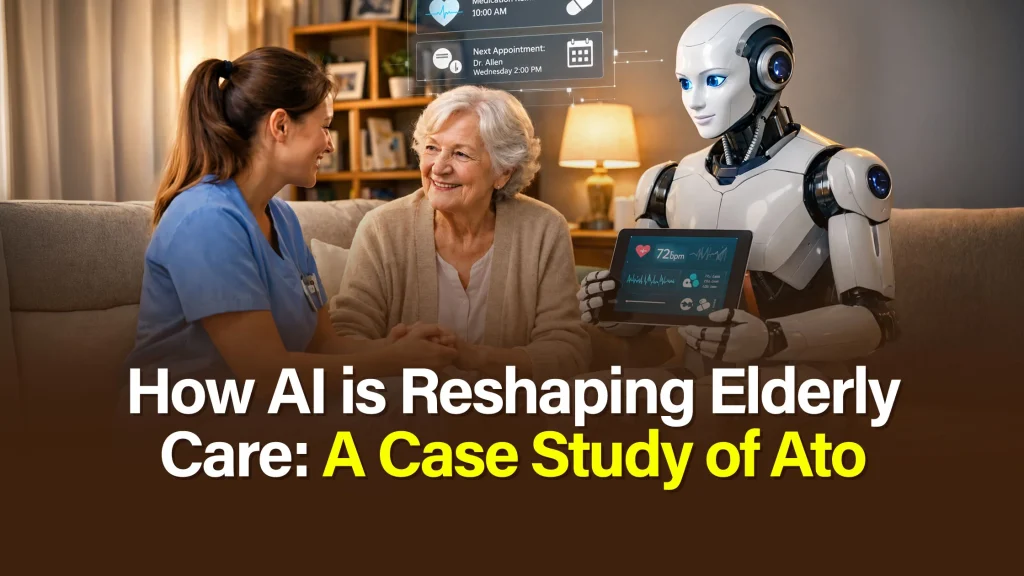
How AI is Transforming Elderly Care – What We Can Learn from Ato.ai
As global populations age, society faces a never before demographic change. Millions of older adults live independently or experience social isolation, which clinical studies have linked to health risks comparable to smoking 15 cigarettes a day. Simultaneously, family caregivers, often part of the “sandwich generation” juggling careers, children, and aging parents, are experiencing mounting burnout and mental fatigue.
At this crossroad Artificial Intelligence makes a lot of sense, if looked at it with the right perspectives. While media coverage frequently focuses on enterprise automation or generative art, some of AI’s most meaningful applications are happening in the quietest spaces of our lives: the living rooms and bedrooms of older adults. Modern AI is helping us to address the emotional, social, and day-to-day needs of seniors.
In this blog, we explore how AI is reshaping elderly care, looking closely at Ato.ai, a pioneering AgeTech company proving that technology can bridge the gap between independence and support.
The Digital Divide in Senior Care
For decades, the tech industry attempted to solve senior isolation through conventional consumer electronics: tablets, smartphones, and mainstream smart displays. Yet, these solutions frequently missed the mark. They relied on visual accuracy, fine motor skills, and multi-layered menus that sometimes frustrate senior users. For an 85-year-old dealing with arthritis or declining eyesight, pinching a screen, downloading an app, or remembering a password is a barrier.
The industry needed a complete shift. Instead of forcing seniors to adapt to complex technology, technology needed to adapt to seniors. This realization paved the way for ambient, voice-first artificial intelligence designed specifically around natural human conversation.
Case Study: Ato.ai – A Voice-First Approach
Founded in San Francisco by Juan Cereigido and Gaspar Habif, Ato.ai was born out of an AI for good mission: building a better, more natural way for older adults to stay connected. Frustrated by the friction of mainstream tech, the founders engineered a screen-free, tabletop AI companion explicitly designed for seniors.
Instead of forcing users to navigate apps or screens, Ato operates entirely through natural, latency-free voice conversation. Here is how Ato.ai is chaging elderly care across three major pillars:
1. Proactive Companionship & Combating Loneliness
Loneliness isn’t just an emotional hurdle; it is a major public health crisis when it is happening to a large group of people in a country or region. Unlike traditional voice assistants that remain passive until spoken to, Ato takes a proactive approach. It initiates natural conversations based on the user’s daily routines, checking in, sparking memories, and keeping seniors mentally sharp. With an average user age of 82, the device doesn’t talk down to seniors – an approach tested and failed which make seniors feel like being treated as kids – it treats them with intellectual respec.
2. Assisting Family Caregivers Without Sacrificing Privacy
One of the heaviest burdens on family members is the constant anxiety of whether their aging loved one is safe and okay. Ato addresses this through an integrated Family App built on a strict privacy-first framework:
- Peace-of-Mind Reports: Caregivers receive activity summaries confirming their loved one is active and engaged, without ever listening to or recording private conversations.
- Two-Way Messaging: Families can send quick text updates to the device, which Ato reads aloud, allowing seniors to reply seamlessly using their voice.
- Routine Reminders: Caregivers can easily schedule audible prompts for medications, doctor appointments, and daily tasks, reducing missed doses and administrative mental load.
3. Exceptional Retention and Market Validation
In the AgeTech sector, user retention is notoriously difficult, with many devices eventually gathering dust in a drawer. However, Ato’s relentless feedback loop, talking weekly with its users in their 80s and 90s, has yielded an extraordinary 60% retention rate, nearly triple the industry average. By scaling through early access programs and expanding into assisted living pilots, Ato demonstrates that when AI is designed with extreme empathy, seniors accept it wholeheartedly.
What Ato.ai Teaches Us About the Future of AgeTech
The success of Ato.ai highlights several critical lessons for developers, healthcare providers, and innovators looking at the massive caregiving economy:
- Accessibility is Screen-Free: For older generations, the future is not behind a glowing touchscreen. Voice-first, ambient computing removes the friction of modern user interfaces.
- Dignity Over Surveillance: Caregiving tech often swings too far toward heavy surveillance, making seniors feel monitored or stripped of autonomy. Ato’s privacy-first architecture proves that safety and dignity can peacefully coexist.
- Closing the Intergenerational Gap: Technology should bring families closer, not create technological divides. By enabling seamless voice-to-text messaging between a senior’s tabletop companion and a relative’s smartphone app, AI can make a difference in the fragmented communication lines created due to the digital divide.
The unanswered hurdle
While Ato’s approach feels like a breakthrough, screens still play an essential role for older adults facing speech limitations. If a senior experiences a declining voice or vocal fatigue, a purely voice-first model hits an immediate bottleneck.
Furthermore, voice recognition errors can lead to miscommunication, potentially giving caregivers a false sense of security or unnecessary concern. This particular challenge can be resolved with advanced conversational AI architectures and custom speech recognition training tailored to the unique vocal patterns of each individual users.
End Card: It’s a Positive Step
Artificial Intelligence in elderly care is no longer just on vision boards; it is an active reality. Companies like Ato.ai show us how impactful AI can be in helping solve real social challenges.
As we look ahead, we can look forward to more and more successful implementations of AI that help to ease the pressure on nations to handle the global aging population.