The RTCO Prompt Framework: A Simple Way to Get Better Answers from AI
Written by the Airtics Education academic team. Reviewed by an Airtics program advisor. Last updated 25 June 2026.
Table of Contents
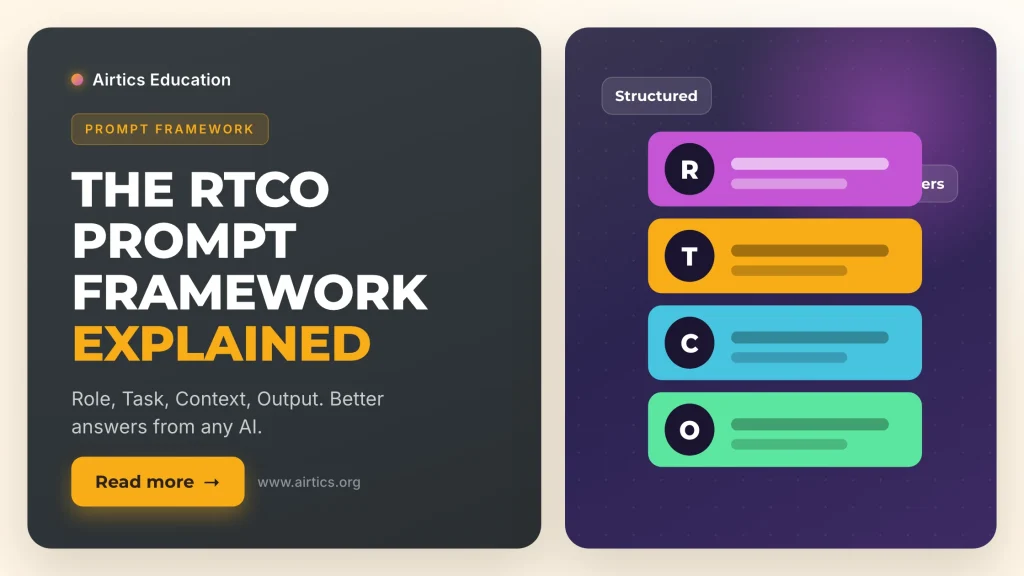
RTCO is a simple prompt framework that stands for Role, Task, Context and Output. You tell the AI who to be, what to do, what it needs to know, and how to format the answer. That small bit of structure turns a vague request into a clear brief, and it is the fastest way to get better, more reliable results from tools like ChatGPT, Claude and Gemini. Below is what each part means, a full worked example, and why structured prompts work so well.
What is the RTCO prompt framework?
Most people type a one line request into an AI tool and then feel let down by a generic answer. The problem is rarely the tool. It is the prompt. RTCO fixes that by breaking a prompt into four simple parts:
- R is for Role. Who should the AI act as? Giving it a role anchors its tone and expertise. “You are a senior data analyst” produces a very different answer from no role at all.
- T is for Task. What exactly do you want it to do? Be specific and use clear action words.
- C is for Context. What background does it need? Your situation, your audience, any constraints, data or numbers that shape the answer.
- O is for Output. How should the answer look? A table, a numbered list, a word count, a tone. State it plainly.
Think of it as the difference between telling an intern “write something about careers” and briefing a consultant with a clear scope. Same person, very different result.
A full example: weak prompt vs RTCO prompt
Here is the kind of prompt most people write:
Give me tips for a data analyst interview.
It works, but the answer will be generic. Now here is the same request written with RTCO:
Role: You are a hiring manager who has interviewed 200 data analysts.
Task: Give me the seven most common interview questions and a strong sample answer for each.
Context: I am a junior analyst in Dubai with one year of experience, applying for a mid level role at a bank. I know SQL and Power BI well, but I am weak on statistics.
Output: A numbered list. For each question, one short ideal answer and one mistake to avoid. Keep the whole thing under 600 words.
The second prompt gives the AI a role to play, a precise task, the context that actually matters (your experience, your city, your weak spot), and a clear format. The answer comes back focused, practical, and ready to use. You did not work harder. You just briefed better.
Why AI tools love structured prompts
It helps to understand how these tools work. A large language model answers by predicting the most likely useful continuation of your input. The clearer and more organised your input is, the less it has to guess, and guessing is exactly what produces vague answers.
- Labels act as signposts. Words like Role, Task and Output tell the model how to read each part of your request. Studies on prompt structure suggest that clear delimiters can improve accuracy by roughly 16 to 24 percent.
- Structure in means structure out. When you state the output format, the model has a clear target to aim at, so you stop getting a wall of text when you wanted a table.
- Context removes ambiguity. Most generic answers come from missing context. RTCO forces you to add it, so the model tailors the response to you.
- It is repeatable. A good RTCO prompt becomes a template you reuse, which means consistent quality instead of starting from scratch every time.
Why the framework matters
RTCO is worth learning for a few practical reasons. It saves time, because you get a usable answer on the first try instead of three rounds of back and forth. It gives consistent quality, because the structure does not change even when the topic does. And it is tool agnostic, so the same habit works in Claude, ChatGPT, Gemini and Copilot. As AI tools spread through workplaces across the UAE and the wider GCC, the people who can brief them clearly are the ones who get more done. It is quietly becoming a core professional skill.
A reusable RTCO template
Role: You are [the expert you need].
Task: [exactly what you want, in clear action words].
Context: [your situation, audience, constraints, any data].
Output: [format, length, tone].
Want even better results? Add an example. Some people call this RTCO+E, where the E is for Examples. Showing a short “before and after” or a sample of the style you want often beats describing it. For more hands on tips, see our guide to Claude prompt hacks for data work and the essential AI tools for data science.
Frequently asked questions
What is the RTCO prompt framework?
RTCO stands for Role, Task, Context and Output. It is a simple structure for writing clear prompts that get better, more relevant answers from AI tools like ChatGPT and Claude.
What does RTCO stand for?
Role, Task, Context and Output. You tell the AI who to be, what to do, what it needs to know, and how to format the answer.
Why do structured prompts work better?
They remove ambiguity. Clear labels and a stated output format give the AI a precise target, so it guesses less and returns a more useful, relevant result.
Is RTCO better than other prompt frameworks?
RTCO is one of the simplest and easiest to remember. Others such as CO-STAR or RACE add more detail, but RTCO covers the essentials and works well for most everyday tasks.
Do I need to use RTCO for every prompt?
No. For quick questions a plain prompt is fine. Use RTCO when the task is important, complex, or something you plan to repeat.
Does the RTCO framework work with Claude and ChatGPT?
Yes. The framework is tool agnostic, so it works with Claude, ChatGPT, Gemini, Copilot and other AI assistants.
Learning to work well with AI is a skill, and it pairs best with real data fundamentals. Talk to an Airtics advisor about an accredited, online program for working professionals in the UAE and GCC. Chat on WhatsApp or request a free callback.
Want guidance on your next step?
Thinking about upskilling? Tell us your goal and an Airtics advisor will point you to the right program, with no obligation.